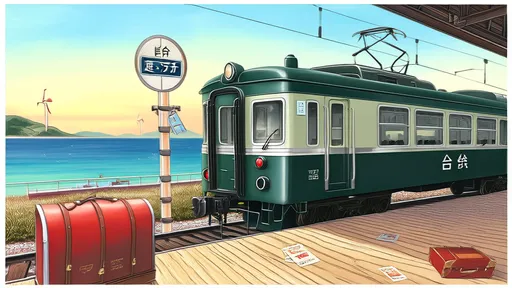
The railway lines of Taiwan hold a special charm for both locals and travelers, weaving through scenic landscapes and connecting towns with a rich cultural heritage. Among these routes, the coastal line between Zhuifen and Chenggong stations stands out not just for its picturesque views but also for a unique tradition that has captured the hearts of many: the commemorative stamping of train tickets. This practice, deeply rooted in Taiwanese railway culture, transforms a simple journey into a cherished memory.
Zhuifen Station, located in Taichung, is the starting point of this coastal adventure. Its name, which translates to "dividing the score," carries a playful homophone in Mandarin that means "to marry." This linguistic quirk has turned the station into a popular spot for couples and students, who believe that purchasing a ticket from Zhuifen to Chenggong—literally "to succeed"—brings good luck in love or exams. The whimsy of this belief is a testament to how deeply railway culture is intertwined with everyday life in Taiwan.
Upon boarding the train, passengers are greeted by the rhythmic clatter of wheels against tracks as the landscape shifts from urban sprawl to coastal vistas. The journey itself is a leisurely one, allowing travelers to soak in the views of the Taiwan Strait, where the azure waters meet the horizon. The train makes several stops along the way, each offering a glimpse into the slower pace of life in Taiwan's smaller towns. It’s a stark contrast to the high-speed rail that zips through the island, and therein lies its appeal.
Arriving at Chenggong Station, the end of the line, passengers are met with more than just the satisfaction of a completed journey. Here, the tradition of stamping tickets takes center stage. Near the exit, a small table holds an ink stamp bearing the station’s name and the date. Visitors eagerly press their tickets onto the stamp, creating a personalized souvenir. For many, this simple act is a ritual—a way to mark not just the trip but a moment in time. The stamped ticket becomes a keepsake, often tucked into wallets or scrapbooks as a tangible reminder of the adventure.
The practice of stamping tickets is not unique to Chenggong, but it holds particular significance here due to the station’s auspicious name. Students, in particular, flock to the station during exam seasons, hoping that the stamped ticket will serve as a talisman for success. The belief may be superstitious, but it underscores the emotional connection people have with the railways. In a world where digital transactions are replacing paper tickets, this tradition preserves a tactile, nostalgic experience.
Beyond the stamping ritual, the Zhuifen-Chenggong line offers a window into Taiwan’s railway history. The stations along the route retain much of their original architecture, with wooden beams and tiled roofs that harken back to the Japanese colonial era. The trains themselves are older models, their interiors worn but welcoming, with large windows that frame the passing scenery like moving postcards. Riding this line feels like stepping back in time, a stark contrast to the modernity that defines much of Taiwan’s infrastructure.
For travelers looking to immerse themselves in local culture, the Zhuifen-Chenggong journey is a must. It’s not just about the destination but the stories woven into every stop, every stamp, and every smile exchanged between passengers. The stamped ticket is more than a memento—it’s a symbol of the joy found in slow travel, in taking the time to appreciate the journey as much as the arrival. And in a fast-paced world, that’s a lesson worth remembering.
The tradition of stamping tickets may seem small, but it reflects a larger cultural ethos in Taiwan—one that values connection, tradition, and the simple pleasures of life. Whether you’re a student seeking luck, a couple celebrating love, or a traveler chasing nostalgia, the Zhuifen-Chenggong line offers something special. So the next time you find yourself in Taiwan, skip the high-speed rail for a day. Take the coastal line, stamp your ticket, and let the rhythm of the rails carry you into a story of your own making.
The gentle sway of a cruise ship, the endless horizon stretching beyond your private balcony, and the whisper of sea breeze through your hair – these are the hallmarks of an unforgettable voyage. Yet seasoned travelers know that not all balcony cabins are created equal. The subtle art of selecting the optimal cabin based on wind direction, known as cabin orientation strategy among cruise enthusiasts, can dramatically enhance your sailing experience. This often-overlooked aspect of cruise planning separates casual vacationers from discerning nautical adventurers.
Modern cruise ships, those floating cities of steel and glass, present unique wind dynamics that change with the vessel's direction, speed, and weather conditions. The prevailing wind patterns across different decks and along the ship's length create microclimates that affect everything from balcony enjoyment to cabin temperature. Savvy travelers have learned to decode these invisible currents, transforming what might be an ordinary cabin into a perfectly positioned sanctuary.
Wind direction relative to the ship's movement creates distinct zones of airflow across the vessel. When sailing into headwinds, the forward sections experience stronger breezes that can make balcony use challenging. Conversely, following winds create calmer conditions aft, while beam winds produce varying effects along the port and starboard sides. The ship's superstructure creates wind shadows and acceleration zones that defy simple prediction, requiring a nuanced understanding of naval aerodynamics.
The phenomenon known as apparent wind – the combination of true wind and wind generated by the ship's movement – plays a crucial role in balcony comfort. At cruising speeds of 20-24 knots, this can add 10-15 knots to the perceived wind speed on exposed balconies. Forward-facing cabins particularly bear the brunt of this effect, while aft cabins often enjoy relative calm as they sit in the ship's wind shadow. Mid-ship locations present a compromise, with wind patterns that change less dramatically during course alterations.
Seasoned cruisers develop preferences based on itinerary and personal tolerance for breeze. Caribbean sailings might warrant windier cabin positions for natural cooling, while Alaskan voyages could benefit from more sheltered locations. The ship's architecture further complicates matters – protruding lifeboats, superstructure overhangs, and recessed balcony designs all modify local wind effects in ways that aren't always apparent from deck plans.
Technology has entered this realm of cruise planning through innovative wind mapping applications. Some cruise lines now provide virtual models showing predicted wind patterns across decks at various speeds. Third-party developers have created algorithms that factor in ship design, typical routes, and seasonal weather patterns to suggest optimal cabin selection. Yet these tools remain imperfect, unable to account for the unpredictable nature of ocean winds and last-minute itinerary changes.
The psychological aspect of wind exposure shouldn't be underestimated. What one traveler experiences as refreshing breeze, another may find uncomfortably windy. Children and elderly passengers often prefer more sheltered locations, while honeymooners might enjoy the dramatic wind-swept ambiance of forward suites. Cruise lines have responded to these preferences by creating wind-protected balcony designs – with angled glass barriers or recessed configurations – particularly on newer vessels.
Weather patterns add another layer of complexity to cabin selection. Trade wind routes create consistent patterns that experienced cruisers can anticipate, while variable weather regions demand more flexible strategies. The Mediterranean's unpredictable gusts differ markedly from the steady Caribbean easterlies or the powerful winds encountered on transatlantic crossings. Savvy travelers cross-reference historical weather data with cabin location when planning extended voyages.
Ship movement interacts with wind direction in ways that affect balcony usability. In beam seas, windward cabins may experience spray and strong gusts, while leeward cabins remain calm. Following seas can create unusual wind patterns where airflow actually moves forward relative to the ship. These phenomena explain why some cruisers insist on changing cabins for different legs of a journey, or why world cruisers often migrate between cabins seasonally.
The debate between port and starboard preference often centers on wind patterns during scenic cruising. In destinations like Alaska's Inside Passage or Norway's fjords, the dominant wind direction may determine which side offers better viewing conditions. Local knowledge becomes invaluable here – for instance, knowing that Glacier Bay's katabatic winds typically flow from starboard to port can influence cabin choice for glacier viewing days.
Cabin selection strategies must also consider the ship's itinerary changes. A transatlantic crossing presents different wind considerations than a Mediterranean hop between islands. Seasoned travelers develop mental maps of how wind patterns shift with latitude and prevailing weather systems. The Coriolis effect even plays a subtle role, influencing wind circulation patterns differently in northern and southern hemispheres.
Newer cruise ship designs attempt to mitigate wind issues through architectural innovations. Cunard's Queen Mary 2 features in-hull balconies that provide shelter from North Atlantic winds, while Celebrity's Edge series uses cantilevered balconies with wind deflectors. These design elements create micro-environments that challenge traditional wind patterns, requiring passengers to research specific ship characteristics rather than relying on general rules.
The economic aspect of wind-optimized cabins presents an interesting market dynamic. Contrary to expectations, the most sheltered cabins don't always command premium prices. Forward suites with dramatic windswept views often top the price charts, while mid-ship balcony cabins – offering a compromise between shelter and view – consistently maintain strong resale value. Discerning travelers can sometimes find excellent value in aft cabins that combine wind protection with stunning wake views.
Environmental concerns are beginning to influence this discussion as well. Some cruise lines now position wind turbines or other renewable energy devices in areas of predictable airflow, which can affect nearby cabin conditions. The growing emphasis on fuel efficiency has led to hull and superstructure designs that modify traditional wind patterns, meaning that advice from a decade ago may no longer apply to newer vessels.
Personal experimentation remains the ultimate teacher in mastering cabin selection by wind patterns. Many veteran cruisers maintain detailed journals noting wind conditions at various cabin locations, creating personalized reference guides refined over multiple voyages. This empirical approach often yields insights that contradict conventional wisdom, revealing unexpected pockets of calm or particularly pleasant breeze patterns on specific ships.
As cruise ships continue to evolve in size and design, the calculus of wind-optimized cabin selection grows more complex. The megaships of today create their own localized weather patterns that dwarf those of traditional vessels. Yet the fundamental pleasure of standing on your private balcony, feeling exactly the right amount of sea breeze, remains one of cruising's simplest yet most sophisticated joys – a reward for those who take the time to understand the invisible dance of wind and wave.

By /Aug 13, 2025

By /Aug 13, 2025
By /Aug 13, 2025
By /Aug 13, 2025
By /Aug 13, 2025

By /Aug 13, 2025

By /Aug 13, 2025

By /Aug 13, 2025
