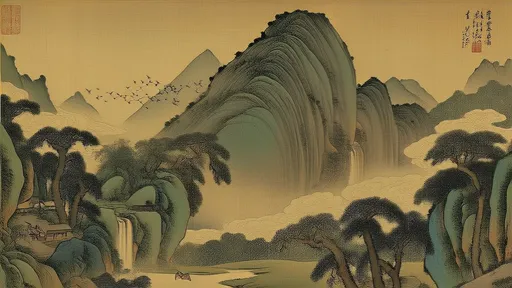
The Northern Song Dynasty (960–1127) represents a golden age in Chinese landscape painting, where artistic vision and philosophical depth converged to create enduring masterpieces. Among its many achievements, the era birthed what scholars now call the "Three Great Masters" – Li Cheng, Fan Kuan, and Guo Xi – whose works established compositional paradigms that would influence Chinese art for centuries. Their paintings weren't merely depictions of nature but visual manifestations of cosmological principles, where towering peaks and misty valleys embodied the harmony between heaven, earth, and humanity.
These artists developed distinct yet interconnected approaches to spatial organization that went beyond technical innovation. Fan Kuan's Travelers Among Mountains and Streams, for instance, employs a monumental verticality where the central mountain dominates two-thirds of the silk scroll, creating what later critics termed the "lofty distance" (gaoyuan) perspective. The composition's power derives from its deliberate imbalance – the sheer cliff face overwhelms the tiny human figures at its base, evoking the Neo-Confucian concept of nature's sublime indifference to human affairs.
Li Cheng's Reading the Stele demonstrates an alternative paradigm now called "level distance" (pingyuan). Unlike Fan's confrontational verticality, Li arranges elements horizontally across receding planes, inviting the viewer on a visual journey through layered space. His compositions often feature withered trees with "crab-claw" branches and "demon-face" knots – stylistic signatures that became codified in later painting manuals. The emotional resonance comes from subtle asymmetries; a scholar gazes at a weathered stele while his attendant looks away, creating narrative tension within the serene landscape.
Guo Xi, the youngest of the trio, synthesized their innovations in works like Early Spring, which exemplifies "deep distance" (shenyuan). His "angle-of-totality" technique combines multiple viewpoints within a single scroll – peaks viewed from below, mid-ground elements at eye level, and distant mountains seen as if from above. This compositional dynamism reflects his theoretical writings in Lofty Message of Forests and Streams, where he compares ideal landscapes to "a gentleman's virtuous mind": structured yet fluid, imposing yet approachable.
The secret grammar of these compositions lies in their treatment of negative space. Unlike Western perspective systems that privilege the viewer's fixed position, Song landscapes use ink washes and blank silk to suggest atmospheric qi (energy) flowing between forms. In Fan Kuan's work, mist isolates the central peak like a celestial throne; Li Cheng employs voids to imply continuation beyond the scroll's edges; Guo Xi's swirling clouds guide the eye along predetermined visual pathways. This "breathing space" creates what 11th-century critics called "living rhythm" (qiyun), transforming static images into meditative experiences.
Recent multispectral imaging of Fan Kuan's masterpiece revealed underdrawings that confirm the calculated nature of these compositions. Grid lines and proportional markers show how the "three distances" theory was systematically applied, with key elements positioned according to the golden ratio. The foreground boulder occupies exactly 38% of the lower register – not by accident, but to create deliberate tension with the mountain's mass. Such findings underscore how these artists balanced spontaneity with mathematical precision, a duality central to Chinese aesthetic philosophy.
Modern viewers often miss the political subtext encoded in these landscapes. The towering central peaks in Fan Kuan's works mirrored the imperial bureaucracy's hierarchical structure, while Li Cheng's scholar-recluses embodied the educated elite's dual role as government servants and spiritual seekers. Guo Xi, who served as court painter to Emperor Shenzong, explicitly linked compositional principles to social order in his treatise: "As a mountain has its principal peak, so a state has its sovereign." The paintings' tranquil surfaces thus concealed sophisticated ideological statements about power, duty, and withdrawal.
The legacy of these compositional strategies endured well beyond the Song collapse. When 14th-century Yuan dynasty literati painters rejected courtly styles, they ironically retained the "three distances" framework while inverting its meanings – using sparse brushwork to convey political dissent. Even in contemporary Chinese art, traces of this visual language persist; digital media artist Yang Yongliang's Artificial Wonderland series reconstructs Song mountain compositions using photographs of urban sprawl, proving the paradigm's adaptability across millennia.
What makes the Northern Song approach unique in global art history is its fusion of technical mastery with metaphysical ambition. Unlike European Renaissance perspective that sought to replicate human vision, or Islamic geometric abstraction representing divine order, Song painters created a middle way – landscapes that felt simultaneously real and symbolic, immediate and eternal. The "three distances" weren't just viewing angles but pathways to enlightenment, inviting viewers to mentally traverse the painting as a Daoist might journey through sacred mountains.
As museums increasingly display these works alongside global masterpieces, new audiences discover their sophisticated visual language. The 2023 Metropolitan Museum exhibition "Mountains That Speak" demonstrated how Fan Kuan's compositional tension parallels Cézanne's Mont Sainte-Victoire series, while Li Cheng's spatial pauses resonate with Rothko's color fields. Such cross-cultural dialogues affirm the Three Great Masters' enduring relevance – their mountains still speak, if we learn to listen.
The world of fine art has always relied on innovative techniques to preserve the integrity of delicate mediums. Among these, pastel paintings present unique challenges due to their powdery nature. The development of specialized fixatives for pastel works represents a significant advancement in art conservation, allowing these vibrant creations to withstand the test of time while maintaining their distinctive texture and luminosity.
Pastel fixatives serve as invisible guardians of artwork, creating a molecular bond with pigment particles without altering the visual characteristics that make pastel works so distinctive. Unlike traditional varnishes that create a glossy film over oil paintings, quality pastel fixatives penetrate between pigment particles, stabilizing them while preserving the matte finish and velvety texture that collectors and artists cherish. This delicate balance between protection and preservation requires sophisticated chemical formulations that have evolved significantly since early fixative attempts using simple resins dissolved in alcohol.
The chemistry behind modern pastel fixatives involves complex polymer solutions designed to create flexible, durable bonds with pigment particles. Contemporary formulations typically use acrylic resins or other synthetic polymers suspended in a solvent base that evaporates completely after application. These advanced materials differ from early shellac-based solutions that often yellowed over time or became brittle with age. The molecular structure of modern fixatives allows for slight movement of the paper support while maintaining pigment adhesion - crucial for works that may experience changes in humidity or temperature.
Application techniques play an equally important role in the successful preservation of pastel works. Professional conservators recommend spraying fixative in multiple light layers rather than single heavy applications. This gradual approach prevents the saturation of paper fibers which can lead to warping or pigment displacement. The ideal distance for spraying ranges between 10-12 inches from the artwork surface, with each layer allowed to dry completely before applying the next. Many experts suggest holding the spray can at a consistent 45-degree angle to ensure even coverage without creating concentrated spots of fixative.
Environmental considerations have become increasingly important in fixative formulation. Many manufacturers now offer low-VOC (volatile organic compound) options that provide equivalent protection while minimizing health risks to artists and environmental impact. These water-based alternatives have gained popularity in studio environments, though some traditionalists maintain that certain alcohol-based formulations provide superior results for specific pastel techniques. The debate continues within artistic circles, with ongoing research into bio-based fixatives that might offer sustainable solutions without compromising archival quality.
The interaction between fixative and different pastel types presents another layer of complexity. Soft pastels, with their high pigment concentration and minimal binder, require particular care during fixation to prevent color shifts or darkening. Harder pastels and oil pastels respond differently to various fixative formulations, necessitating artist experimentation to achieve optimal results. Many professional pastelists develop personal protocols through years of practice, often creating custom approaches for different stages of a work - using light fixation during the building phase and finalizing with more thorough applications upon completion.
Archival testing has revealed that properly fixed pastel works can rival the longevity of oil paintings when created with quality materials and stored under appropriate conditions. Accelerated aging tests conducted by conservation laboratories demonstrate that contemporary fixative formulations can protect pigment particles for centuries without significant alteration to color or texture. These findings have encouraged major museums to reconsider pastel works as permanent collection pieces rather than fragile objects requiring excessive handling restrictions.
Historical context sheds light on how far pastel preservation has advanced. Eighteenth-century pastel portraits by masters like Rosalba Carriera or Maurice Quentin de La Tour survived despite primitive fixation methods, often relying on glassine paper or careful framing to protect surfaces. The development of the first commercial fixatives in the 19th century represented a breakthrough, though these early formulations often compromised the delicate nuances of pastel strokes. Today's artists benefit from centuries of technical refinement, allowing for creative expression without sacrificing permanence.
The future of pastel fixation technology points toward increasingly specialized solutions. Nanotechnology applications show promise for creating molecular-level protective barriers that would be virtually undetectable to the eye or touch. Research into pH-neutral formulations aims to eliminate all risk of paper degradation over extended periods. Some laboratories are experimenting with UV-absorbing additives that could provide additional protection against light damage without affecting color integrity. These innovations continue to expand the possibilities for pastel as a serious medium for both contemporary artists and conservators of historical works.
Professional art conservation circles have established specific protocols for dealing with unfixed historical pastel works. These delicate procedures often involve localized fixation under controlled conditions, sometimes using customized solutions applied with precision airbrushes rather than aerosol sprays. The conservation approach must balance stabilization needs with preservation of original texture and the artist's intentional surface qualities. Such meticulous work highlights the importance of proper initial fixation in contemporary practice to avoid complex conservation challenges for future generations.
Artist education remains crucial in promoting best practices for pastel fixation. Many art schools now include detailed instruction on fixation techniques as part of their curriculum, emphasizing the relationship between application methods and long-term preservation. Workshops led by master pastelists frequently devote significant time to demonstrating proper fixation approaches for different styles and techniques. This knowledge transfer ensures that emerging artists understand fixation not as an afterthought, but as an integral part of the creative process that affects how their work will endure.
The commercial market for pastel fixatives has expanded dramatically in recent decades, offering artists an array of specialized products. From workable fixatives that allow for continued layering to final fixatives designed for maximum protection, the options cater to diverse technical requirements. Some manufacturers even offer tinted fixatives that can subtly enhance certain color groups or pH-balanced formulations specifically for delicate papers. This product diversification reflects the growing recognition of pastel as a versatile and permanent artistic medium worthy of sophisticated preservation technology.
Scientific analysis of aged pastel works provides valuable feedback for fixative improvement. Advanced imaging techniques allow conservators to examine how different fixation methods have performed over decades or even centuries. This forensic approach to art materials science informs the ongoing refinement of commercial products, creating a virtuous cycle of innovation. Microscopic examination reveals how various formulations interact with pigment particles at a structural level, guiding chemists in developing ever more effective solutions.
As pastel continues to gain recognition in the contemporary art market, the importance of proper fixation becomes increasingly apparent to collectors and galleries. Auction houses now frequently include fixation information in provenance documentation, recognizing its impact on long-term value. Insurance appraisers consider fixation quality when assessing works for coverage, knowing that properly preserved pieces will maintain their condition far into the future. This institutional recognition underscores how fixation technology has elevated pastel from a supposedly ephemeral medium to one embraced by serious collectors.
The dialogue between artists, chemists, and conservators continues to push the boundaries of what's possible in pastel preservation. Annual symposiums bring together these diverse experts to share findings and set research priorities. Such collaborations have led to breakthroughs like humidity-resistant formulations and fixatives that accommodate mixed-media approaches. This interdisciplinary approach ensures that pastel fixation technology will keep pace with evolving artistic practices while maintaining uncompromising standards for permanence.
Ultimately, the story of pastel fixatives reflects broader themes in art materials science - the marriage of tradition and innovation, the balance between immediate artistic needs and long-term preservation, and the ongoing quest to perfect the tools of creative expression. As formulation technology advances, artists gain greater freedom to work with this luminous medium without concerns about its durability, ensuring that future generations will experience pastel works with the same freshness and vitality intended by their creators.
By /Aug 11, 2025

By /Aug 11, 2025
By /Aug 11, 2025
By /Aug 11, 2025
By /Aug 11, 2025
By /Aug 19, 2025
By /Aug 11, 2025
By /Aug 11, 2025
