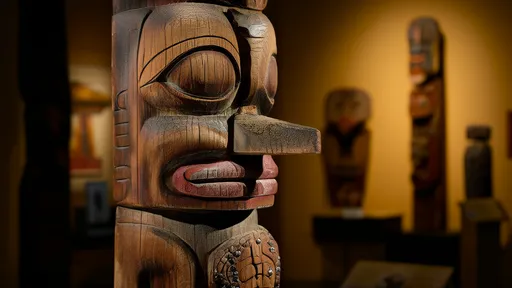
The enigmatic beauty of African tribal sculpture has long captivated collectors and scholars alike, yet its deeper ritual significance remains widely misunderstood in Western discourse. These are not mere aesthetic objects created for passive contemplation, but powerful vessels of spiritual energy shaped by cosmological principles that govern entire communities. From the dense forests of the Congo Basin to the arid Sahel, sculptural traditions manifest as physical articulations of invisible forces - what anthropologist Marcel Griaule termed "the spoken forms of the ancestors."
At the core of this artistic tradition lies a fundamental paradox: the most visually striking figures often serve the most utilitarian ritual purposes. The Bambara people's chi wara antelope crests, for instance, appear as masterpieces of abstract design to foreign eyes, yet farmers understand them as agricultural talismans whose zigzag patterns map the ideal sowing trajectory. Similarly, the Yoruba ere ibeji twin figures gain their polished surfaces through daily anointing with sacrificial materials, their visual perfection being a byproduct of spiritual maintenance rather than artistic intention.
The Dogon people of Mali provide perhaps the most sophisticated example of this phenomenon. Their monumental kanaga masks, when viewed through Western art historical lenses, appear as striking examples of geometric modernism. However, Dogon elders explain these forms as three-dimensional representations of the god Amma's creative process - the upper crossbar symbolizes the celestial realm, the lower section the earthly plane, and the connecting vertical element the axis mundi along which divine energy flows. During dama funeral ceremonies, dancers donning these masks don't perform for an audience, but rather become conduits for cosmic forces, their movements tracing the soul's journey through the afterlife geography.
Materiality itself carries profound ritual implications that transcend formal qualities. The Baoulé people distinguish between blolo bla (spouse from the spirit world) figures carved from dark, dense wood and waka sran (bush spirits) rendered in lighter timber - a differentiation that references the varying densities of spiritual realms. Kongo nkisi power figures accumulate layers of medicinal substances (bilongo) in their abdominal cavities, their visual potency increasing as they become more "used" in healing rituals. This stands in direct opposition to Western conservation ethics that prize original surface conditions, revealing fundamentally different conceptions of an artwork's lifecycle.
Contemporary scholarship has begun uncovering the sophisticated semiotic systems underlying these sculptural traditions. Luba royal staffs (tshibola) employ a complex language of crenellations and concave surfaces that serve as mnemonic devices for reciting dynastic histories. The protruding umbilicus on many Chokwe ancestor figures (mwanangana) doesn't merely represent physical anatomy, but symbolizes the uninterrupted lineage flowing between living and dead. Even the seemingly abstract patterns on Senufo poro initiation masks correspond to specific esoteric teachings revealed only to society members after decades of graded knowledge acquisition.
Perhaps most radically, these traditions challenge the very Western dichotomy between "artist" and "artisan." Among the Dan people, carvers enter trance states to allow spirit forces (du) to guide their tools, considering themselves not creators but translators of pre-existing spiritual forms. The Lega of DR Congo judge the efficacy of their bwami society sculptures not by visual criteria, but by how successfully they provoke moral reflection during initiation rituals. This reorientation from product to process, from object to effect, demands a complete rethinking of artistic valuation systems.
As global interest in African art continues to grow, museums face increasing ethical dilemmas regarding display methodologies. The British Museum's 2022 reinstallation of its Benin Bronzes alongside contextual ritual footage marked a tentative step toward more culturally sensitive presentation. However, many traditional custodians argue that certain power objects lose their meaning entirely when removed from active ritual use, regardless of exhibition context. The late Yoruba sculptor Olowe of Ise once remarked that his palace doors "sleep" when not animated by seasonal ceremonies - a poignant metaphor for the limitations of institutional preservation.
Recent collaborations between anthropologists and contemporary African artists have yielded fascinating hybrid interpretations. Nigerian artist Peju Alatise incorporates traditional Gelede mask proportions into installations critiquing gender violence, while Congolese painter Chéri Samba reimagines nkisi figures as commentators on modern politics. These developments suggest that the ritual logic of African sculpture remains vibrantly adaptive, even as its forms migrate into new contexts. The enduring power of these traditions lies precisely in their ability to straddle worlds - connecting visible and invisible realms, past and present, individual and cosmos through the silent language of sculpted form.
In the quiet glow of the furnace, where molten glass shimmers at 1200°C, an unspoken dialogue unfolds between master and apprentice. This is the realm of collaborative glassblowing—a dance of fire, timing, and trust that transforms glowing silica into delicate artistry. The craft, often misunderstood as solitary work, thrives on symbiotic partnerships where seasoned artisans and their protégés breathe life into form through synchronized movements and shared intuition.
The process begins at the glory hole, that radiant mouth of heat where raw materials surrender to liquidity. Here, the master gathers the first gather of glass on the blowpipe, rotating steadily to maintain symmetry while the apprentice watches the viscosity like a hawk. There’s a moment—a split second—when the molten glass reaches the ideal consistency for inflation. The master nods almost imperceptibly; the apprentice hands over the wooden block, its surface dampened just enough to prevent sticking. No words are exchanged. The tools change hands as if guided by magnetism, their edges meeting at precisely the angle needed to shape the swelling bubble.
Temperature governs everything. A miscalculation of mere degrees can turn supple glass brittle or send it slumping into a shapeless mass. Veterans read heat like poets read meter—the way orange fades to cherry red indicates workability, the speed at which the gather cools dictates when to reheat. Apprentices learn to anticipate these rhythms, preemptively stoking the furnace or fetching the jacks before the master’s hand twitches toward them. "It’s like jazz improvisation," describes Matteo Rossi, a third-generation glassblower from Murano. "The melody is the technique, but the harmony comes from knowing your partner’s next breath."
Centuries-old techniques bind these partnerships. The "servente" system, born in Venetian workshops, formalizes the hierarchy while emphasizing interdependence. A master may dictate the overall form, but the apprentice’s role in marvering (rolling the pipe on steel tables) or applying color cane determines the piece’s structural integrity. When a goblet’s stem is being pulled, the younger assistant must mirror the master’s steps backward, maintaining tension without overstretching. Fail, and the glass snaps; succeed, and the stem tapers to hair-thin perfection. These maneuvers require muscle memory so deeply ingrained that hands move faster than conscious thought.
The transfer of knowledge is tactile, not textual. Ancient recipe books for glass mixtures exist, but the nuances of handling molten silica resist documentation. How much pressure to apply when twisting the punty rod? What’s the exact wrist flick needed to flare a vase’s lip? Such wisdom passes through fingertips—the master guiding the apprentice’s grip during a gather, their calloused hands overlapping as they simultaneously turn the pipe. In New York’s Corning Studio, educator Emily Traynor recalls her mentor’s teaching style: "He’d let me make mistakes until the piece was nearly unsalvageable, then step in with a correction so precise it felt like time reversed."
Modern collaborations now transcend studio walls. International artist residencies pair glassblowers from disparate traditions—Japanese craftsmen renowned for precision teaming with Swedish designers favoring organic asymmetry. The friction of styles births innovations: borosilicate glass meets Edo-period color layering, or Czech engraving techniques enhance Australian bush-inspired forms. Social media accelerates this cross-pollination; Instagram reels showcase real-time tag-team blowing where artists from rival studios finish each other’s movements with telepathic accuracy.
Yet the core remains unchanged. Whether in a Venetian fabbrica or a Seattle cooperative, successful glassblowing partnerships share one non-negotiable element: mutual vulnerability. The master must trust the apprentice not to flinch when 2000°F heat licks at their sleeves; the apprentice must believe the master won’t let their inexperience shatter hours of work. It’s this fragile balance—much like the material they sculpt—that makes collaborative glassblowing not just a craft, but a testament to human connection forged in fire.
By /Aug 11, 2025

By /Aug 11, 2025
By /Aug 11, 2025
By /Aug 11, 2025
By /Aug 11, 2025
By /Aug 11, 2025
By /Aug 11, 2025

By /Aug 11, 2025
